

Listeners:
Top listeners:
 play_arrow
 Cosoro Afrobeats UK's No.1 Afrobeats Radio Station
 play_arrow
 Cosoro Pidgin Na we bi di No.1 UK Pidgin Radio
 play_arrow
 Cosoro Evergreen UK's No.1 Radio for Timeless African Sounds


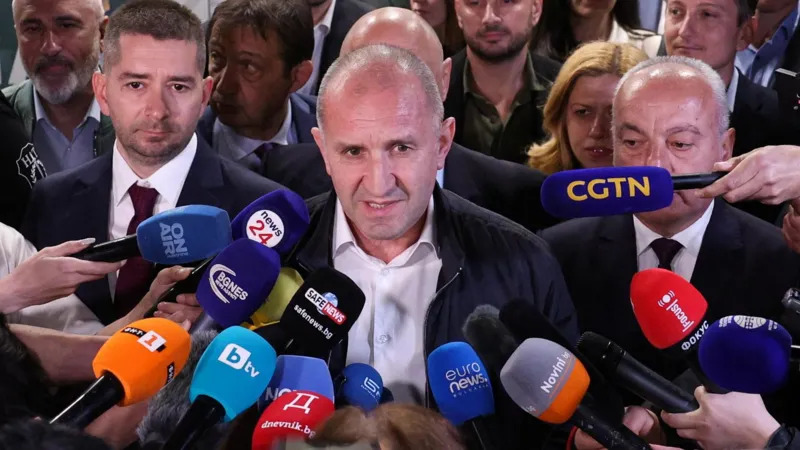
Photo Credit: Reuters
Bulgaria’s former president, Rumen Radev, has secured a sweeping victory in the country’s parliamentary elections, positioning himself to form the first single-party government in nearly three decades and potentially reshaping the nation’s political direction.
Radev, a former fighter pilot and widely known for his Russia-friendly views, won the largest share of the vote seen in a generation. His win follows years of political instability in Bulgaria, which has endured eight elections in five years amid fragile coalitions and corruption scandals.
The result marks a decisive shift away from traditional political parties, many of which have struggled to maintain public trust. Campaigning on an anti-corruption platform, Radev urged voters to reject what he described as entrenched elites, a message that resonated strongly with a frustrated electorate.
Having stepped down from the presidency earlier this year to contest the election, Radev leveraged his nearly decade-long tenure as head of state to project stability during a turbulent political period. Analysts say this helped him stand out against rivals associated with repeated coalition failures.
His newly formed political party, Progressive Bulgaria, secured a commanding lead, reportedly around 44–45% of the vote, securing a majority of 135 seats in the 240-seat parliament. Ex-prime minister Boiko Borisov’s GERB party came second with 13.4%, with the liberal PP-DB coalition third with 12.8%.
Radev’s victory is likely to raise concerns among European allies due to his past criticism of EU policies and opposition to military support for Ukraine. He has also called for improved relations with Russia, prompting speculation about a possible shift in Bulgaria’s foreign policy direction.
Despite this, analysts suggest he is unlikely to take drastic steps that could jeopardize Bulgaria’s membership in the European Union or its access to vital EU funding. Instead, he is expected to pursue a more diplomatic approach, balancing domestic priorities with international obligations.
While the election result may bring political stability, Radev faces significant challenges at home. Bulgaria continues to grapple with corruption, economic pressures, and public disillusionment with political institutions.
Observers note that while his victory gives him a strong mandate, expectations will be high for tangible reforms. Questions also remain about the depth of his policy agenda, with critics pointing to a campaign that was at times vague on specifics.
Even so, the scale of his victory underscores a strong public desire for change following years of political deadlock. As Radev prepares to form a government, his leadership is set to define Bulgaria’s next chapter, both domestically and on the European stage.