

Listeners:
Top listeners:
 play_arrow
 Cosoro Afrobeats UK's No.1 Afrobeats Radio Station
 play_arrow
 Cosoro Pidgin Na we bi di No.1 UK Pidgin Radio
 play_arrow
 Cosoro Evergreen UK's No.1 Radio for Timeless African Sounds



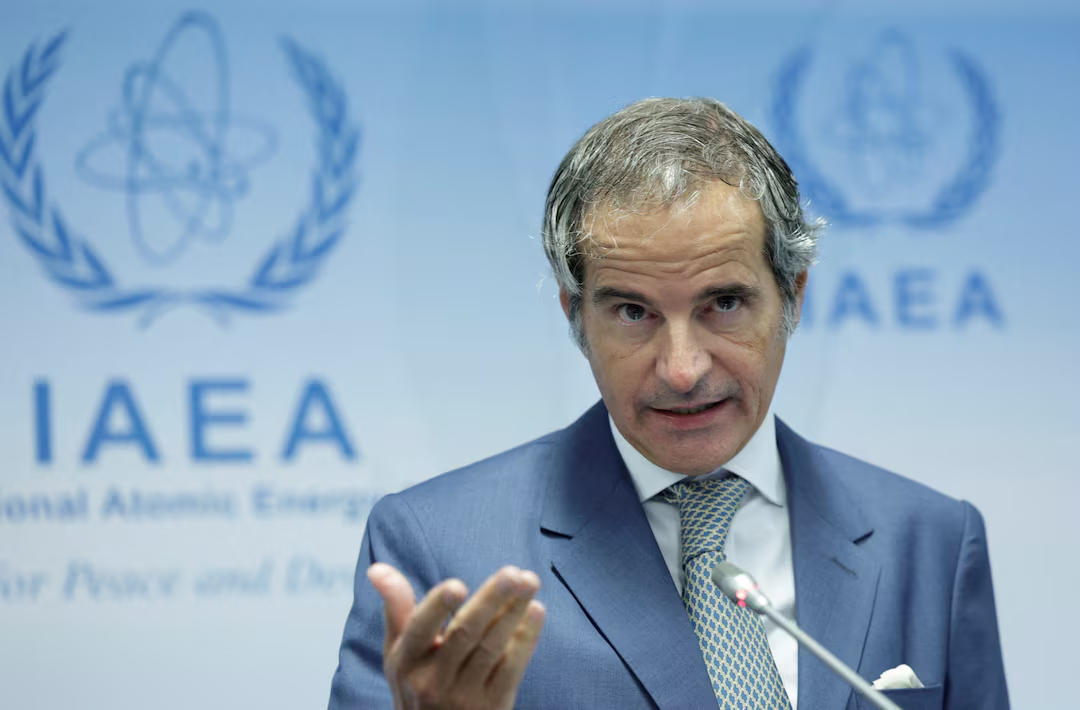
Image Credit: REUTERS
The head of the International Atomic Energy Agency (IAEA), Rafael Grossi, has called for a “very strong verification system” for Iran’s nuclear programme, stressing that international inspectors must be allowed to confirm the status of the country’s nuclear activities as negotiations between Tehran and Washington continue.
Grossi’s remarks come just days after the United States and Iran agreed to a 60-day diplomatic framework aimed at easing tensions following months of conflict. Although the agreement is intended to pave the way for a broader settlement, questions remain over when United Nations inspectors will regain full access to Iran’s nuclear facilities. Grossi said inspections are essential if the agreement is to be credible, adding that intentions alone are not enough without independent verification.
The IAEA is the United Nations agency responsible for monitoring nuclear programmes around the world to ensure nuclear material is used for peaceful purposes. It carries out inspections, verifies compliance with international agreements and reports its findings to member states. Its role has been central to international efforts to monitor Iran’s nuclear activities for more than two decades.
Concerns surrounding Iran’s nuclear programme date back to the early 2000s, when the IAEA began investigating undeclared nuclear activities. In 2015, Iran reached the Joint Comprehensive Plan of Action (JCPOA) with six world powers, agreeing to limit uranium enrichment and accept extensive international inspections in exchange for sanctions relief. However, the agreement began to unravel after the United States withdrew in 2018, prompting Iran to gradually reduce its commitments and increase uranium enrichment.
Today, one of the biggest concerns for international inspectors is Iran’s stockpile of highly enriched uranium. Before recent military strikes on Iranian nuclear facilities, the IAEA estimated that Iran possessed about 440.9 kilograms of uranium enriched up to 60% purity. While this is below the roughly 90% enrichment generally associated with nuclear weapons, experts say it is technically close enough that further enrichment could significantly shorten the time needed to produce weapons-grade material if Iran chose to do so. Iran has consistently maintained that its nuclear programme is solely for peaceful civilian purposes and denies seeking nuclear weapons.
Grossi said the immediate priority for inspectors will be to verify that IAEA seals placed on previously monitored nuclear material remain intact and to establish whether any nuclear material has been moved following recent attacks on Iranian facilities. He acknowledged that discussions with Iranian officials have already begun on the technical arrangements needed to resume inspections, although Tehran has indicated that access to some sensitive sites remains tied to progress in wider negotiations and sanctions relief.
The latest developments highlight the delicate balance between diplomacy and verification. While recent talks have opened the door to renewed cooperation, international observers argue that any lasting agreement will depend on the IAEA’s ability to independently monitor Iran’s nuclear activities. As negotiations continue over the coming weeks, the agency’s inspections are expected to play a central role in determining whether the current diplomatic momentum can develop into a durable and verifiable agreement.