

Listeners:
Top listeners:
 play_arrow
 Cosoro Afrobeats UK's #1 Afrobeats Radio Station
 play_arrow
 Cosoro Pidgin Na we bi di #1 UK Pidgin Radio
 play_arrow
 Cosoro Evergreen UK's #1 Radio for Timeless African Sounds



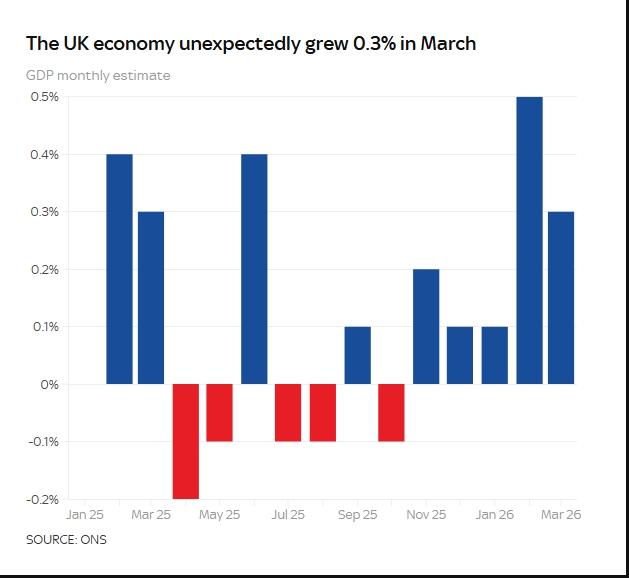
The UK economy unexpectedly expanded at the start of the Iran war, offering a rare sign of resilience as global markets braced for the economic fallout from rising tensions in the Middle East.
New figures released by the Office for National Statistics (ONS) showed Britain’s economy grew by 0.3% in March, outperforming forecasts that had predicted stagnation or decline amid growing fears over energy prices and international instability. The stronger-than-expected performance pushed overall first-quarter growth to 0.6%, marking one of the country’s strongest quarterly showings in recent months.
The data came as conflict involving Iran began sending shockwaves through global energy and financial markets. Oil prices climbed sharply following concerns over potential disruptions to shipping routes in the Strait of Hormuz, one of the world’s most critical energy corridors. Analysts had warned that the UK — heavily dependent on imported energy — could be among the hardest-hit major economies if the conflict escalates further.
Despite those concerns, several sectors of the British economy posted stronger activity during March. Services, manufacturing, construction, advertising, and wholesale trade all contributed to the growth surprise, suggesting businesses and consumers continued spending even as geopolitical tensions intensified.
The figures provide a political boost for Prime Minister Keir Starmer and Chancellor Rachel Reeves, whose government has faced mounting pressure over inflation, weak productivity, and fears of another cost-of-living squeeze. Reeves described the GDP figures as evidence that the government’s economic strategy was beginning to stabilize the country after years of uncertainty.
However, economists cautioned against reading too much into a single month of growth. Some analysts believe businesses accelerated orders and spending in anticipation of future disruption, meaning the positive data could prove temporary if energy prices continue rising.
Financial experts also warned that Britain may still face a difficult economic period later in the year. The ongoing Iran conflict has already increased costs for manufacturers and importers, while households remain under pressure from elevated food, housing, and fuel prices.
The Bank of England now faces a growing challenge as it balances slowing global growth against the risk of renewed inflation driven by energy costs. While weaker economic conditions would normally encourage interest rate cuts, rising oil and gas prices may force policymakers to keep borrowing costs higher for longer.
International forecasts have already become more cautious. The Organisation for Economic Co-operation and Development (OECD) recently downgraded Britain’s growth outlook more sharply than that of any other major G20 economy, citing vulnerability to external energy shocks and weakening consumer confidence.
For now, the latest GDP figures offer a moment of relief for the UK government and financial markets. But with the Iran conflict continuing to threaten global trade and energy supplies, economists warn the country’s economic resilience could soon face a far more difficult test in the months ahead.