

Listeners:
Top listeners:
 play_arrow
 Cosoro Afrobeats UK's #1 Afrobeats Radio Station
 play_arrow
 Cosoro Pidgin Na we bi di #1 UK Pidgin Radio
 play_arrow
 Cosoro Evergreen UK's #1 Radio for Timeless African Sounds


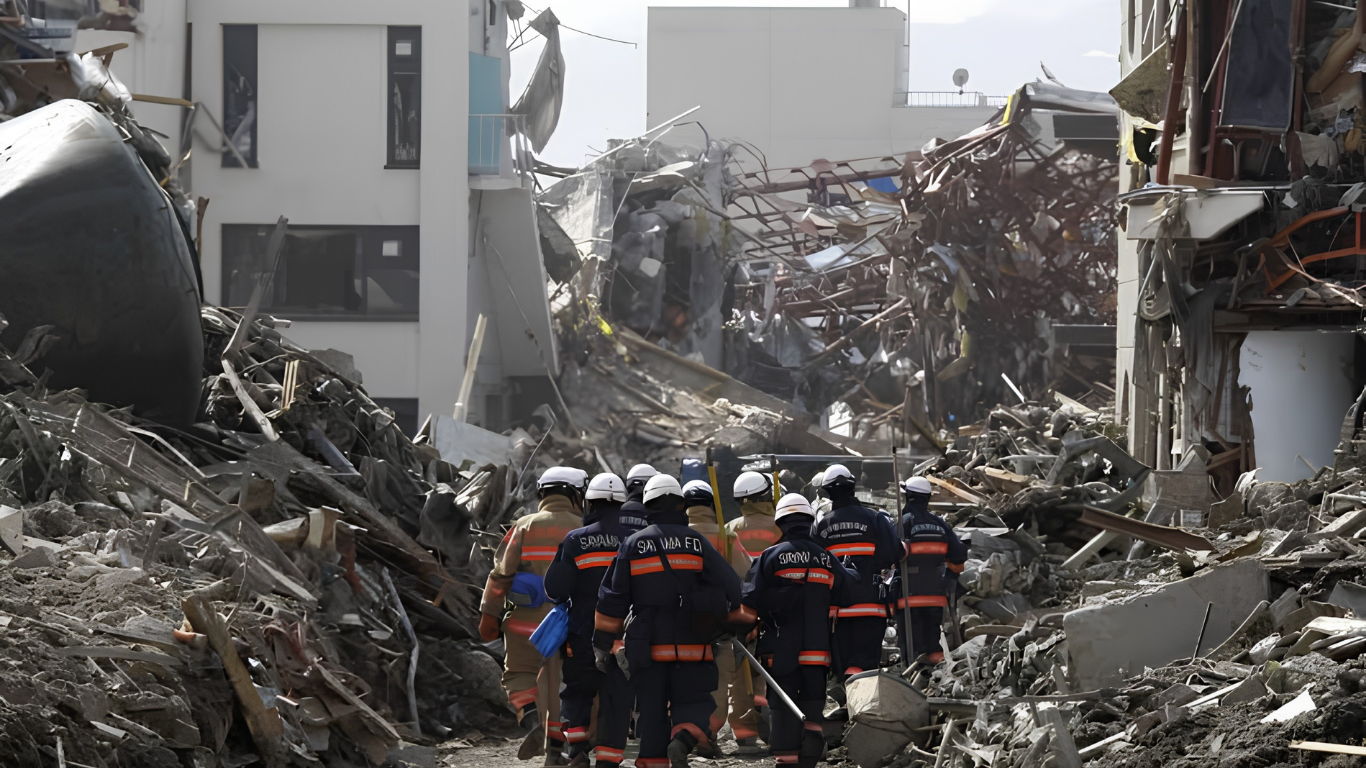
A powerful 7.1-magnitude earthquake struck Japan’s south-western Kyushu region on Tuesday, trapping several people inside a shopping centre, damaging infrastructure and prompting authorities to evacuate more than 150,000 residents as emergency crews raced to respond.
According to the Japan Meteorological Agency (JMA), the earthquake struck inland in Kumamoto Prefecture at approximately 4:27 p.m. local time, with a shallow depth of about 10 kilometres. The agency briefly issued a tsunami warning following the quake, but later lifted it after determining there was no significant threat to coastal communities.
The most serious incident was reported at the Aeon Mall in Kumamoto, where emergency officials said numerous people were trapped after part of the building collapsed. Fire authorities also confirmed that the second floor of a shopping complex in the town of Kashima gave way during the earthquake, leaving several people trapped beneath the debris. Local media also reported an explosion at the mall, although authorities were still investigating the cause.
Prime Minister Sanae Takaichi said the government had begun assessing the full extent of the disaster, adding that multiple injuries had already been confirmed. Japanese broadcaster NHK reported that at least 50 people had been taken to hospital, while around 10 residents at an elderly care facility were among those injured.
Rescue operations were launched immediately, with firefighters, police officers, Japan’s Self-Defence Forces and Coast Guard personnel deployed across the affected areas. Chief Cabinet Secretary Minoru Kihara urged residents to remain alert for further instructions and possible aftershocks, encouraging those in heavily affected areas to follow official evacuation guidance.
The earthquake caused widespread disruption across the region. Train services were suspended, roads and bridges suffered visible damage, electricity supplies were interrupted in thousands of homes, and fires were reported in several locations. Authorities warned that transport disruptions and power outages could continue as engineers inspect critical infrastructure.
The Japan Meteorological Agency has cautioned that strong aftershocks remain possible because of the earthquake’s shallow epicentre. Residents have been advised to avoid damaged buildings and prepare for additional seismic activity in the coming days.
The International Atomic Energy Agency (IAEA) also monitored the situation closely following concerns about nearby nuclear facilities. The agency confirmed that the Sendai Nuclear Power Plant, located roughly 100 kilometres from the epicentre, was operating normally and had suffered no damage or safety issues.
Japan sits along the Pacific Ring of Fire, one of the world’s most seismically active regions, where several major tectonic plates meet. The country experiences around 1,500 earthquakes every year and has developed some of the world’s most advanced earthquake-resistant building standards and emergency response systems. Even so, powerful shallow earthquakes such as this one can still cause significant destruction and pose serious risks to communities.
As search-and-rescue operations continue, authorities remain focused on locating those trapped inside collapsed buildings, restoring essential services and assessing the full scale of the damage caused by one of the strongest earthquakes to strike southern Japan in recent years.