

Listeners:
Top listeners:
 play_arrow
Cosoro Afrobeats UK's #1 Afrobeats Radio Station
 play_arrow
Cosoro Pidgin Na we bi di #1 UK Pidgin Radio
 play_arrow
Cosoro Evergreen UK's #1 Radio for Timeless African Sounds


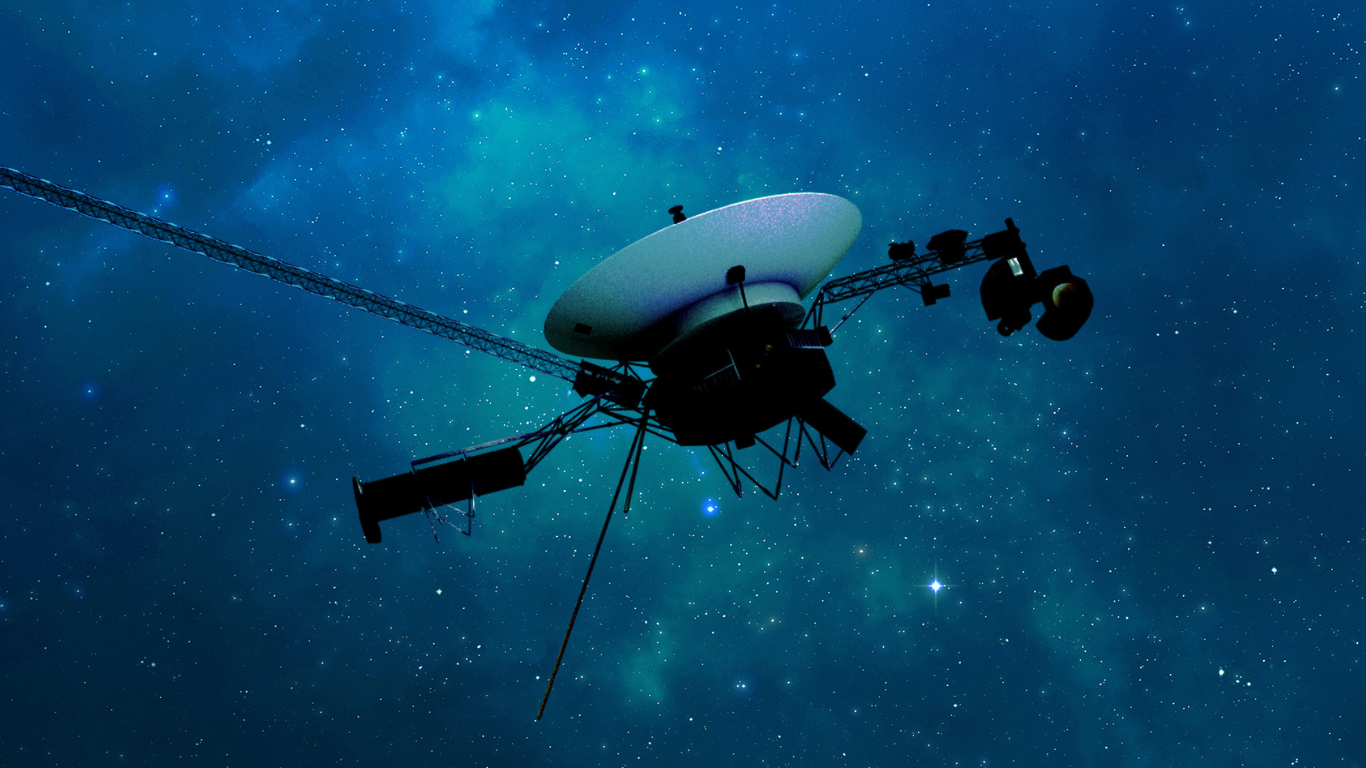
Image Credit: NASA
NASA’s Voyager 1 spacecraft is approaching a historic milestone that will make it the first human-made object to travel one light-day away from Earth. Almost 50 years after its launch, the space probe is expected to reach the extraordinary distance on Wednesday, November 18, 2026, marking another major achievement in humanity’s exploration of the universe.
The milestone represents a distance of approximately 25.9 billion kilometres, or 16.1 billion miles, which is how far light travels in 24 hours. Travelling at roughly 61,000 kilometres per hour, Voyager 1 has spent nearly five decades moving beyond the planets and into interstellar space. Once it reaches the one-light-day mark, a radio signal sent from Earth will take approximately 24 hours to reach the spacecraft, with another 24 hours required for a response to return. This means a simple exchange of messages could take at least two days.
Voyager 1 was launched by NASA on September 5, 1977, with an original mission to explore Jupiter and Saturn. It captured detailed observations of both planets and their moons before continuing its journey towards the outer reaches of the solar system. In August 2012, it became the first spacecraft to enter interstellar space after crossing the heliosphere, the protective bubble created by the Sun’s particles and magnetic field. It remains the most distant human-made object from Earth.
Despite its age and enormous distance, Voyager 1 continues to send scientific information to NASA. Its remaining operational instruments provide measurements of magnetic fields and plasma waves, helping scientists understand the environment beyond the Sun’s influence. The spacecraft also carries the famous Golden Record, a collection of sounds, music, images and greetings from Earth intended as a message to any extraterrestrial civilisation that might encounter it.
NASA has invited people around the world to participate in a symbolic celebration called ‘Shine Bright for Voyager’s Light-Day’ on Tuesday, November 17, the evening before the milestone. Participants are encouraged to shine flashlights or phone lights towards the sky and use Morse code to spell out the mission’s call sign, V-G-R.
Voyager 1’s achievement will underline how far human technology can travel and how long scientific missions can continue to provide discoveries. Its twin spacecraft, Voyager 2, is also travelling through interstellar space but is not expected to reach the same one-light-day distance until November 2035.