
Listeners:
Top listeners:
 play_arrow
 Cosoro Afrobeats UK's No.1 Afrobeats Radio Station
 play_arrow
 Cosoro Pidgin Na we bi di No.1 UK Pidgin Radio
 play_arrow
 Cosoro Evergreen UK's No.1 Radio for Timeless African Sounds



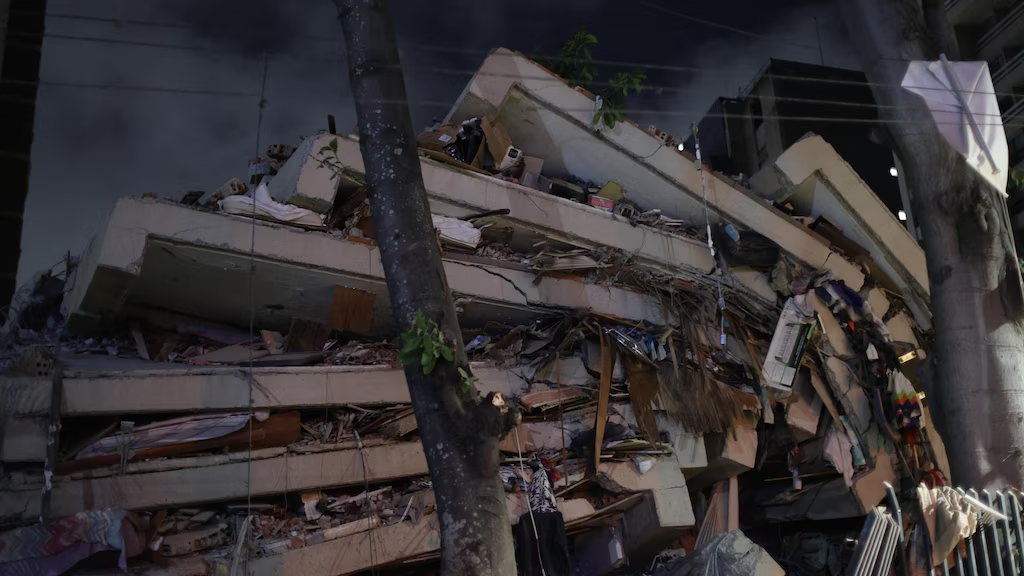
Image Credit: Getty Images
Venezuela is grappling with the aftermath of one of the most powerful earthquakes in its recorded history after twin tremors struck the country’s northern region on June 24. According to the United States Geological Survey (USGS), a magnitude 7.2 earthquake was followed just seconds later by a stronger magnitude 7.5 quake near Morón, about 160 kilometres west of Caracas.
The earthquakes were felt across much of the country, sending residents into the streets as buildings swayed violently. Authorities reported widespread structural damage, while rescue teams were deployed to affected areas. Early reports indicated dozens of deaths and hundreds of injuries, with officials warning that casualty figures could rise as rescue operations continue.
The magnitude 7.5 quake is particularly significant because it is believed to be the strongest earthquake to strike Venezuela since a magnitude 7.7 event in 1900, making it the country’s most powerful seismic event in more than a century.
The disaster has also revived memories of previous major earthquakes in Venezuela. One of the most devastating occurred in July 1967, when a magnitude 6.5 earthquake struck Caracas, killing more than 200 people and causing extensive damage across the capital. The tragedy led to changes in building standards and disaster preparedness measures.
More recently, Venezuela experienced a magnitude 7.3 earthquake in August 2018 near its northeastern coast. Although the quake was widely felt across the Caribbean region, its deeper origin limited the level of destruction compared to the latest disaster. Before this week’s event, the country’s most recent notable tremors occurred in September 2025, when two earthquakes measuring above magnitude 6 struck western Venezuela, causing localized damage but no major loss of life.
Venezuela sits along the boundary of the Caribbean and South American tectonic plates, making it vulnerable to earthquakes. While smaller tremors occur regularly, major destructive earthquakes remain relatively uncommon.
As emergency crews continue search-and-rescue efforts and engineers assess damaged buildings, attention is turning to the long-term recovery process. With aftershocks still being recorded, authorities have urged residents to remain vigilant while the full scale of the disaster becomes clearer.