
Listeners:
Top listeners:
 play_arrow
 Cosoro Afrobeats UK's #1 Afrobeats Radio Station
 play_arrow
 Cosoro Pidgin Na we bi di #1 UK Pidgin Radio
 play_arrow
 Cosoro Evergreen UK's #1 Radio for Timeless African Sounds

Artificial intelligence has become a staple part of the 21st century. With constant emerging technologies, there is no stopping the evolution of AI. Netizens have gradually accepted that AI is here to stay and have begun adapting it into their everyday lives, from workspaces and classrooms to entertainment and communication. However, this rapid integration does not come without ethical considerations.
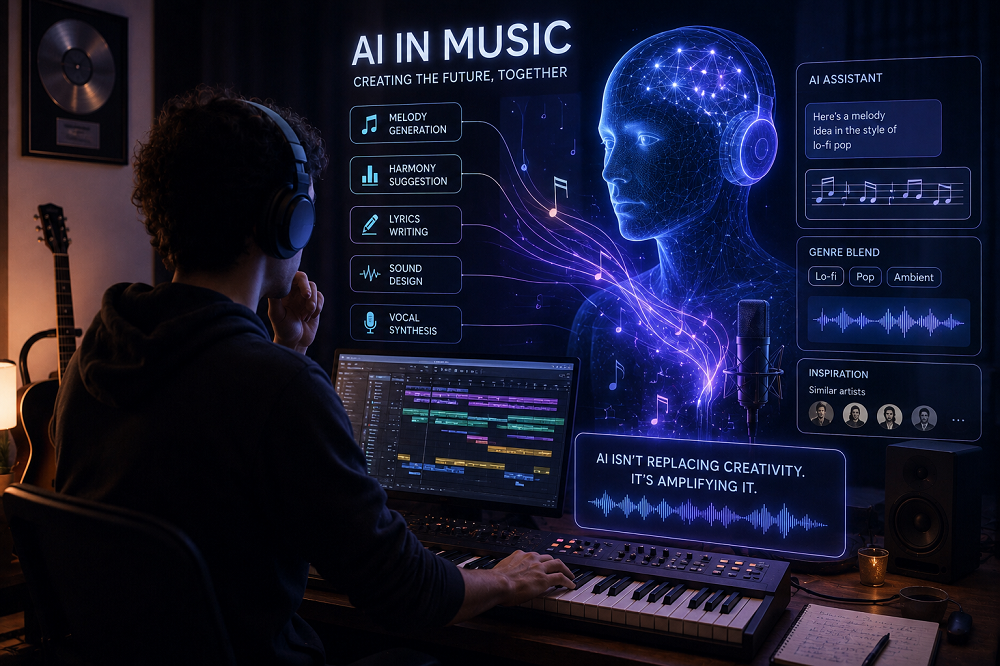
In the music space, artists now use AI to generate melodies, assist with songwriting, improve production quality, mix and master records, create visuals, translate vocals into multiple languages, and even simulate instruments and harmonies that would normally require entire studio sessions. For independent musicians especially, AI has become a cost-saving tool that allows them to experiment creatively without the financial limitations that traditionally came with music production.
The line with AI in music is no longer about whether artists should use it, that debate is already over. The real conversation now is about consent, ownership, attribution, and intent.
As the technology becomes more advanced, the ethical concerns surrounding AI in music are becoming increasingly difficult to ignore, particularly within the Afrobeats industry where snippets, leaks, and online virality are a core part of the culture. Recently, ODUMODUBLVCK shared a song snippet online, only for someone to reportedly use artificial intelligence to generate and circulate a full version of the track before its official release. Around the same time, AI recreations of Asake’s album surfaced online, raising fresh questions about artistic ownership in an era where software can imitate human creativity with alarming accuracy.
While many people viewed these moments as technologically impressive, others saw them as a dangerous overstep. The issue was not necessarily the use of AI itself, but the fact that unfinished artistic expression was taken and completed without the artist’s involvement or consent. In many ways, it changes the relationship between artists and their audiences. Snippets are often intentional previews, creative drafts, or strategic marketing tools. AI now allows fans and internet users to bypass the creative process entirely, generating their own versions before the artist has the chance to fully shape the work.
This is where the ethical divide begins to emerge. There is a significant difference between using AI as a creative assistant and using AI to replicate or exploit someone’s artistic identity. Technology has always played a role in shaping music. Auto-Tune, digital production software, vocal effects, and sampling were all once criticized before becoming widely accepted within mainstream music culture. AI, in many ways, is simply the next stage of that evolution.
However, the ethical concerns become more serious when AI is used to imitate artists without permission, clone voices, finish unreleased songs, or profit from an artist’s likeness without their approval. Music is deeply personal, and for many artists, their voice is not just an instrument but an extension of identity. When AI can reproduce that identity almost perfectly, questions around ownership become inevitable. Who owns an AI-generated song that sounds identical to a real artist? Should a cloned voice be treated as intellectual property? If an AI-generated leak spreads online before an official release, who bears the consequences?
Afrobeats may be particularly vulnerable to these challenges because the genre thrives heavily on online momentum and recognizable individuality. Artists such as Asake, Burna Boy, and Seyi Vibez possess vocal textures and delivery styles that are instantly recognizable to listeners. These unique characteristics are exactly what AI systems are now learning to imitate. In the wrong hands, this could lead to fake collaborations, manipulated leaks, or entirely fabricated songs circulating as authentic releases.
At the same time, it would be unfair to frame AI solely as a threat. When used responsibly, AI has the potential to push music into exciting new territories. It can help upcoming artists create better demos, allow producers to experiment with sound more freely, and open creative opportunities that were previously inaccessible to people without major financial backing. Some artists have even begun integrating AI openly into their creative processes, using it transparently as part of the art itself rather than hiding behind it.
Ultimately, the ethical line may come down to one central principle: consent. AI can be a powerful creative tool when artists choose to use it themselves or authorize its use. The problem begins when the technology is used to imitate, exploit, or replace artists without their knowledge. Transparency also matters. Audiences deserve to know when music has been significantly altered or generated using AI, particularly when the technology is replicating the likeness of a real person.
The reality is that regulation is still struggling to catch up with innovation. Music laws, copyright systems, streaming platforms, and even record labels are still trying to define the limits of AI usage in entertainment. Until clearer boundaries are established, much of the responsibility may fall on audiences, creators, and the culture itself to decide what feels acceptable and what crosses the line.
Because beyond algorithms and software, music remains a deeply human form of expression. AI may be able to imitate the sound of an artist, but many would argue that it still cannot fully replicate the lived experiences, emotions, imperfections, and stories that make music meaningful in the first place.