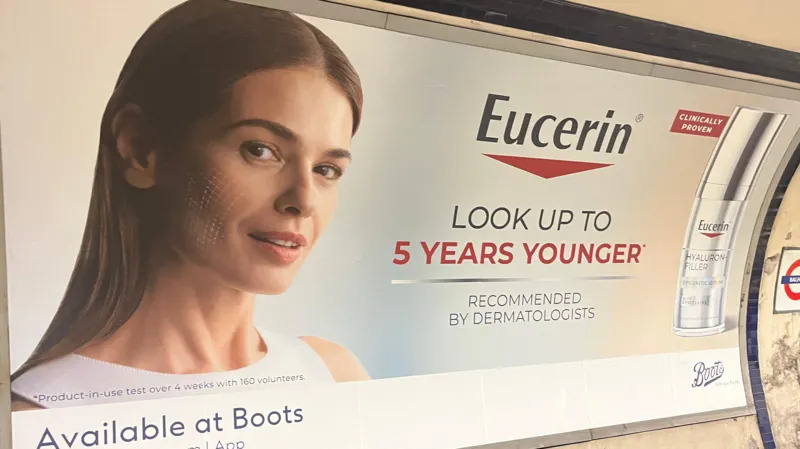
A high-profile advertising campaign for a £49 anti-ageing serum has been pulled after regulators ruled its bold claims were misleading, shining a spotlight on the blurred line between beauty marketing and scientific evidence. The product in question, Eucerin Hyaluron-Filler Epigenetic Serum, promised users they could look “up to five years younger,” a statement that ultimately failed to withstand regulatory scrutiny.
The controversy began when a billboard advertisement appeared in London’s Balham Tube station, catching the attention of a commuter who filed a complaint with the Advertising Standards Authority in November 2025. The ad’s central claim rested on a study involving 160 participants who used the serum over a four-week period. Afterward, participants were asked how much younger they believed they looked. It was this reliance on self-perception—rather than objective measurement—that raised red flags.
In its investigation, the ASA identified several methodological weaknesses that undermined the credibility of the claim. Most notably, the study lacked a control group, making it difficult to determine whether perceived improvements were actually caused by the product or influenced by external factors. Additionally, there was no clear information about how participants were selected, further casting doubt on the reliability of the findings. The regulator also pointed out that the study had been conducted in a different climate from the UK, meaning results might not translate to British consumers.
The manufacturer, Beiersdorf, defended its position by emphasizing that the “up to five years younger” wording was intended to reflect the maximum observed result, not a typical outcome. The company also maintained that its products are supported by scientific research conducted according to industry standards. However, the ASA found that additional evidence submitted—including three unpublished studies—did not sufficiently substantiate the advertising claim. Even a peer-reviewed study cited by the company examined only the serum’s active ingredient, not the finished product itself.
Ultimately, the ASA concluded that the advertisement was misleading and ruled that it must not appear again in its current form. Beiersdorf confirmed that the billboard has since been removed from circulation in the UK.


 play_arrow
  play_arrow
  play_arrow